If there’s only one article you need to read for 2026, it’s this one 👇
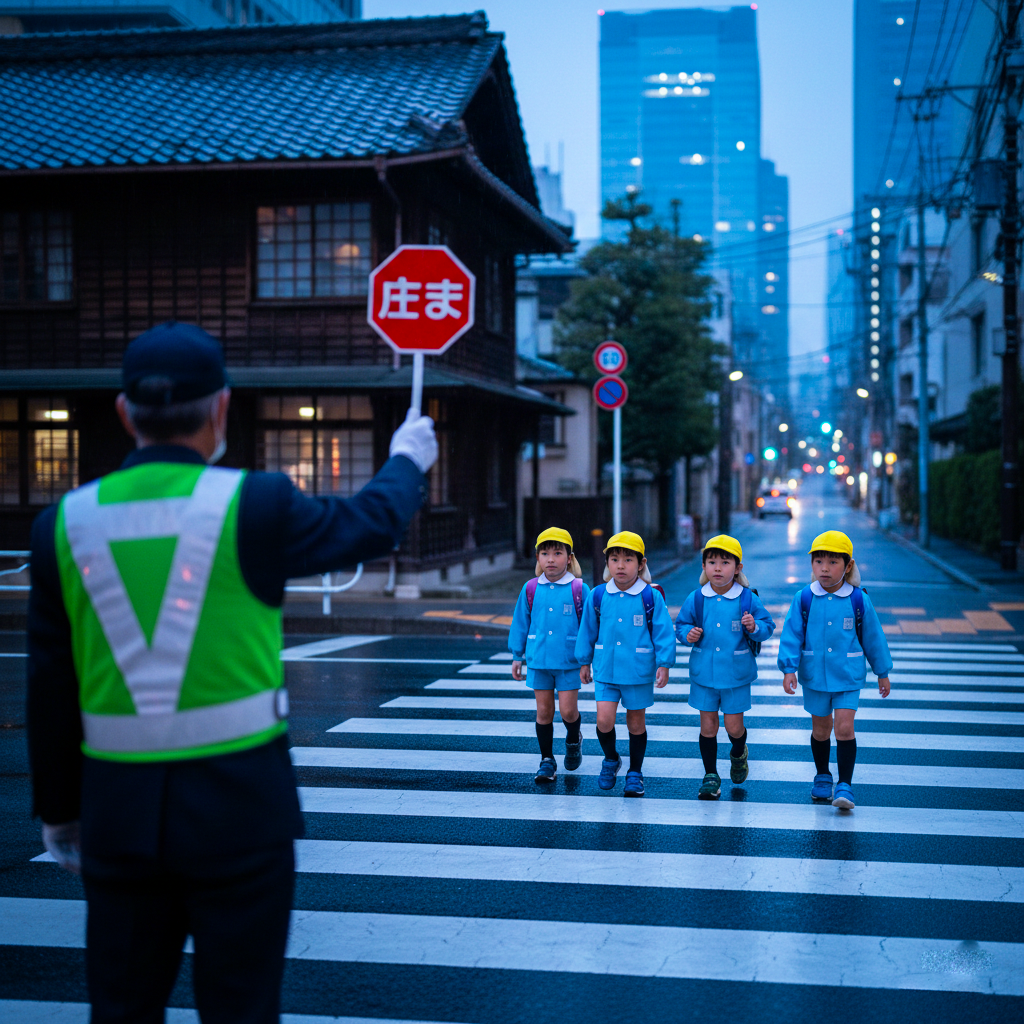
The Dignity of Duty: In Japan, an 80-year-old elder guides the next generation across a Tokyo street. While we honor their resilience, we must ask: Is Canada’s rising cost of living forcing our own seniors toward a future where rest is no longer an option?

I’ve spent over 40 years in the kitchen. I’ve seen the price of a head of lettuce go from cents to dollars, and I’ve watched as families have had to thin out their recipes just to make ends meet. As a Chef, I’ve always believed that the kitchen table is the heart of the home—it’s where we plan our futures and celebrate our hard work.
But lately, there’s an “elephant” sitting at that table, and it’s eating away at the very foundations of our retirement.
I’ll be straight with you: I am biased. I am biased toward the hard-working Canadians who have spent forty years paying into a system they were told would protect them. I’m biased toward my children and grandchildren, who I fear will be left with the bill for today’s government experiments. But while my heart is biased, my eyes are fixed on the facts.
I am Canadian and concerned for our children and grandchildren.
I’ve been looking across the ocean at Japan, and what I see there is a haunting reflection of what could happen here if we don’t hold the line. It’s a comparison that hits home because it’s about more than just numbers—it’s about the dignity of our elders and the survival of our “kitchen table” security.
Here is the reality we face in 2026 and let me begin by saying…
Oh man! It’s 2026. Who knew I would still be alive as many others my age never made it? Are we resilient or just plain lucky? Working towards being healthy helps me creep along, but it also places a silent burden on you as no one likes to mention the “elephant” in the room.
That elephant?
Can we financially sustain your longevity before our retirement funds drain us dry due to rising costs?
In Canada, we have our safety net known as CPP and GIS, but with a crushing tax burden and the rising cost of living, how long can we actually last?
The Japanese Comparison
As hard as it is here, in Japan, it’s worse for the seniors. I feel deeply for them; their culture and government funding systems place a terrible burden on the elderly. The reason I started writing this article is because I noticed viral reels coming directly from Japan, where Japanese seniors are committed to working well into their 70s and 80s. Some can barely walk, and you can see their physical appearance is failing beyond their limitations.
To see a Japanese elder cooking in a small Shokudo (a casual, home-style restaurant) or an Izakaya, struggling to move but forced to serve, is heartbreaking to me. I would never want that to happen to me. It seems fundamentally unfair.
The Heartbreaking “Pension Gap”
While we talk about the struggles of the Canadian dollar, the Japanese National Pension (Kokumin Nenkin) is a drop of water in a desert. In Canada, a low-income senior can often receive a combined monthly total from OAS and GIS that provides a baseline for survival. In Japan, many seniors receive roughly ¥68,000 per month. That is approximately $600 CAD. Imagine trying to pay for rent, medicine, and heat in a modern economy on $600 a month. It isn’t just difficult; it’s a mathematical impossibility.
Working to Survive vs. Working to Thrive
In Canada, we see retirement as a hard-earned finish line. We can go to the gym to keep our bodies strong, or like me, write stories to keep our minds sharp—it’s a choice.
But in Japan, elders are forced into “Silver Human Resource Centers.” These are agencies that find manual labor for people who should be resting.
When you see those viral videos of an elder in a tiny shop, they are often fighting against the fear of becoming a gomi-rojin (trash person)—a cruel term for those who have no purpose. While their sense of duty is noble, it becomes a tragedy when a grandmother is working a 10-hour shift just to avoid being a burden.
The Loneliness Factor and “Kodokushi”
There is a haunting reality in Japan called Kodokushi, or “lonely death.” Many seniors continue to work because the workplace is the only place where they still feel like a human being. In a society where family structures are shrinking, the workplace is the only thing standing between them and total isolation.
A Comparison of Realities- Canada vs Japan
In Canada: Our safety net (OAS/GIS) provides a livable baseline, though it is being stretched thin by inflation. We view retirement as a time for hobbies, health, and family. Our social connections come from gyms, community centers, and creative groups.
In Japan: The pension barely covers a week’s groceries. Retirement is often a “second work phase” required for financial survival. Their social connection is often tied strictly to the job, making the workplace their only sanctuary from a lonely home life.
It is a stark reminder of the security we often take for granted. We must look at the resilient but suffering elders of Japan and realize that without proper support, the “Golden Years” can quickly turn into a lifelong sentence of labor. That being said, our current government is rerouting our much earned senior income into a global uncertainty.
The Canadian Elephant in the Room
The “elephant in the room” is that for the first time in a long time, Canadians are looking at their retirement and wondering if the math still works.
Here are the facts:
1. What is our tax percentage in Canada now (2026)?
The tax burden is a moving target because it depends on your income bracket and province.
However, as of January 1, 2026, there have been some specific shifts:
The “43% Burden” —
When you combine federal tax, provincial tax (which is roughly 10%–15% in most provinces for middle earners), and the high “hidden” taxes like the industrial carbon tax (now $110 per tonne), many Canadians are indeed seeing nearly half their purchasing power vanish.
* Payroll Increases: While income tax went down slightly, CPP and EI premiums went up. If you are earning $85,000 or more, you are paying about $5,770 in payroll taxes alone this year, per person ! That’s a big chunk of your hard earned money !
2. Is our CPP, GIS, and OAS safe?
This is the part that gets people fired up, especially with Mark Carney now as Prime Minister and his background in global finance.
* The Law (CPP): Legally, the Canada Pension Plan (CPP) is not “government money.” It is held by the CPP Investment Board (CPPIB), which operates at “arm’s length” from the government. By law, the government cannot simply “raid” the fund to pay for roads or debt. It is funded by you and your employer, not by general tax revenue.
* The Asset Controversy: Can Carney use it as an “asset.”?
There has been significant debate in the last year about the government encouraging (or pushing) the CPPIB to invest more of those hundreds of billions of dollars inside Canada to boost our own economy, rather than in global markets, which in fact, is a False indicator of our economy. Carney is rerouting your money !
Critics, like the Canadian Taxpayers Federation, argue that this is a “soft raid”—using your retirement security to prop up government economic goals.
* OAS and GIS: Unlike the CPP, Old Age Security (OAS) and the Guaranteed Income Supplement (GIS) are not invested funds. They are paid out of the government’s yearly “general revenue.” This makes them more vulnerable; if the government runs out of money or the debt gets too high, they are the ones who decide the payout rates. Read that last line again – let that sink in !
The Truth of the Matter
I am correct in saying “It is the taxpayers’ money.” The CPP is a “forced savings” plan, not a gift from the state. It’s vital, not to us seniors, but to our children and grandchildren, that you hold the Federal Government accountable because Carney is cleverly rerouting our assets into the global financial market by pushing the CPPIB to invest more. If the market crashes, which it will, our so-called untouchable retirement monies will be drastically reduced due to Carney playing with our financial future.
The Reality in Japan is a Warning to CANADA
Warning Bell 🚨
The comparison I have made to Japan is so vital because Japan shows us what happens when the “safety net” becomes a “spider web”—it catches you, but it doesn’t really support you.
In Canada, we are still “lucky” that the CPP is currently considered one of the most stable pension funds in the world, but with the rising cost of living and the government looking at those trillions of dollars in pension assets with hungry eyes, my skepticism is shared by many.
It won’t effect me but it will effect my children and grandchildren.
Keep the Government Accountable ! That’s the bottom line.






Leave a Reply