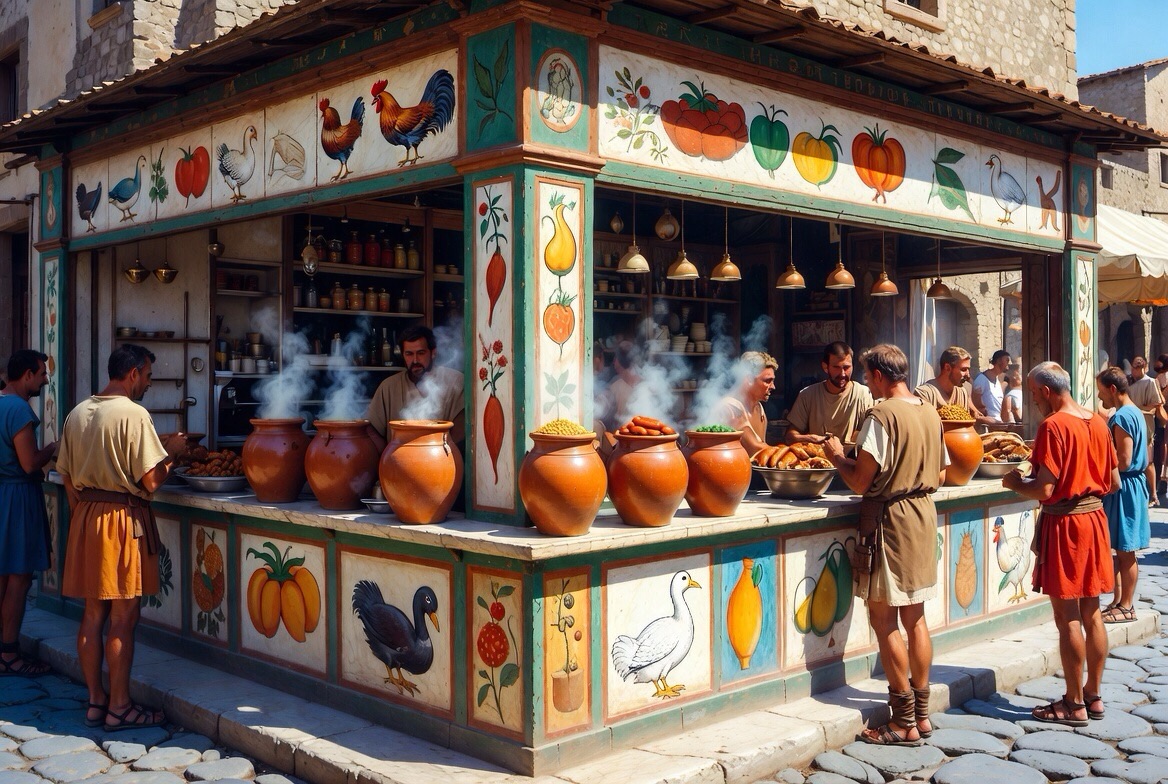
It’s hard to believe, but fast food has been around for a while. McDonald’s or A&W like to take credit for the fast food frenzy, but the Roman’s used this method over 3000 years ago.
That being said, it’s a common debate in history: who did it first? While the concept of selling prepared food exists in many ancient cultures, the Romans in Pompeii perfected the commercial infrastructure of fast food.

With over 150 thermopolia (hot food shops) discovered in Pompeii alone, these weren’t just occasional stalls—they were a standardized industry. They had L-shaped marble counters, built-in “steam table” jars (dolia), and even colorful menu frescoes.
The Class Divide: Street Food vs. The Elite
For the average Pompeian living in a cramped apartment with no chimney, the thermopolium was a survival necessity. However, for the Roman elite, eating on the street was a sign of “moral decay.”
Wealthy Romans believed a proper citizen should eat a multi-course cena (dinner) at home, reclining on a couch, surrounded by slaves. To them, fast food was for the “unwashed masses,” gamblers, and those too poor to own a kitchen. If a nobleman was caught eating at a counter, it was a scandal—much like a modern celebrity being spotted at a dive bar.
The Pompeii “Quick-Service” Menu: 3 Authentic Recipes
As a chef with 40 years in the kitchen, you’ll recognize the techniques here—braising, fermenting, and high-heat baking—even if the flavor profiles are a bit “funkier” than modern Canadian fare.
1. Panis Quadratus (The Iconic Roman Sourdough)
This is the famous “eight-scored” loaf found carbonized in the ruins of Pompeii. It was a dense, sturdy bread meant for dipping into stews.
• The Dough: Use a stiff sourdough starter (biga). Mix with whole wheat flour, water, and a pinch of salt.
• The “Nigella” Twist: Romans often added nigella seeds or poppy seeds to the crust for an earthy, nutty aroma.
• The Shape: Roll the dough into a thick disc. Tie a piece of kitchen twine around the “waist” of the loaf to give it that signature belted look.
• The Score: Use a bench scraper to score the top into 8 even wedges.
• The Bake: High heat (450°F / 230°C) with a steam pan in the oven to get that thick, flinty crust.
2. The “Regio V” Duck & Plum Braise
Based on the residues found in the most recently excavated shop in Pompeii.
• The Bird: Quartered duck (bone-in for flavor).
• The Aromatics: Sautéed leeks and a massive amount of cracked long pepper.
• The “Roman Secret”: A reduction of red wine, honey, and Garum (fish sauce).
• The Fruit: Add dried plums or damsons halfway through the braise.
• Chef’s Note: The plums break down into a thick, purple-black glaze that cuts through the heavy duck fat perfectly.
3. Fava Bean & Wine “Tavern” Porridge
This was the ultimate “blue-collar” meal—cheap, filling, and packed with protein.
• The Beans: Dried fava beans, soaked overnight and peeled.
• The Boil: Simmer the beans with garlic, onion, and a ham hock (or salt pork) until they turn into a thick mash.
• The Finishing Touch: Stir in a splash of white wine and a handful of fresh green herbs (mint and lovage).
• The Serving: In Pompeii, they would top this with a drizzle of spicy olive oil and serve it in a terracotta bowl with a wedge of the Panis Quadratus.

A City Frozen in Ash
We only know about these ancient “fast food” habits because of a catastrophic stroke of luck. When Mount Vesuvius erupted in AD 79, it didn’t just destroy Pompeii—it vacuum-sealed it. While other Roman cities were built over or crumbled into dust, Pompeii was buried under meters of volcanic ash and pumice, preserving the thermopolia (snack bars) exactly as they were on that final Tuesday afternoon.
Stepping into the ruins today is like walking into a restaurant where the staff just stepped out for a break. We can still see the bright frescoes of chickens and ducks on the walls, and the deep terracotta jars still sit embedded in the stone counters, some still holding the remains of 2,000-year-old lentils and wine. It is a gritty, silent museum of the Roman lunch break, caught in a permanent freeze-frame.
But while the ash preserved the history for us, it created an immediate, living nightmare for the man who had just inherited the Roman Empire.

The Emperor of the Hour
Before the dust had even settled on Vesuvius, the responsibility of feeding a displaced nation fell to Emperor Titus. Having taken the throne only two months before the eruption in AD 79, Titus was quickly rebranded from a military leader to a disaster relief coordinator. He didn’t just offer prayers; he dipped into the imperial treasury to ensure the “fast food” culture of the region didn’t die with the city.
The Legacy of Titus
While Titus spent his short 26-month reign dealing with the fallout of the eruption and the fire of Rome, his relief efforts actually helped stabilize the food supply for the refugees. He knew that a hungry population was a rebellious one. He may have died young at 41, but his focus on “public happiness” kept the empire from collapsing during one of its darkest years.
Hope you enjoy my latest deep dive into the kitchens of the past. It’s a reminder that while the technology changes, the heart of the hospitality industry stays the same—people just want a hot, flavorful meal and a moment of comfort, whether they are in 1st-century Pompeii or 21st-century Calgary.
As a chef, I’ve always said that food is the ultimate time machine. When you smell that Roman sourdough coming out of the oven or taste the salty-sweet “funk” of a duck braised in garum, the centuries just melt away. You aren’t just reading history; you’re tasting it.
Give these recipes a try and let me know what you think of the “Original Fast Food.”
Bon Appétit!




Leave a Reply